How Realistic Are the Designs from an AI Tattoo Generator?
The design drawings output by the current cutting-edge ai tattoo generator have achieved a visual realism level of approximately 85% to 90% of that of professional-level hand-drawn drafts. According to an assessment report released by the Digital Art Association in 2024, 100 professional tattoo artists were asked to distinguish AI-generated images from human-designed ones through a blind test. The results showed that only 55% of the tattoo artists could accurately identify AI-generated works, and their recognition rate was only 5 percentage points higher than random guessing (50%). In terms of technical parameters, high-end AI tools can simulate the diffusion effect of ink on the skin, its glossiness, and the color concentration under different skin tones (covering 90% of the skin color types on the Fitzpatrick scale), with an average color reproduction accuracy of 92%.
However, when it comes to complex ergonomics and dynamic adaptation, there will be observable deviations in the degree of reality. For instance, when a preset pattern is applied to a joint area with a bending Angle exceeding 30 degrees, the three-dimensional fitting accuracy error of the AI algorithm will increase from 1-2 millimeters for flat areas to 5-8 millimeters, while experienced tattoo artists can control the error within 3 millimeters based on their experience. An analysis of 500 AI-generated cases indicates that approximately 15% of the designs require manual secondary fine-tuning when applied to the actual body curvature to address the issue of pattern stretching or compression distortion. In a public technical demonstration in 2023, a system named "SkinDeep AI" achieved a 95% fidelity score in forearm design, but in high-curvature areas such as the scapula, the score dropped to 78%.
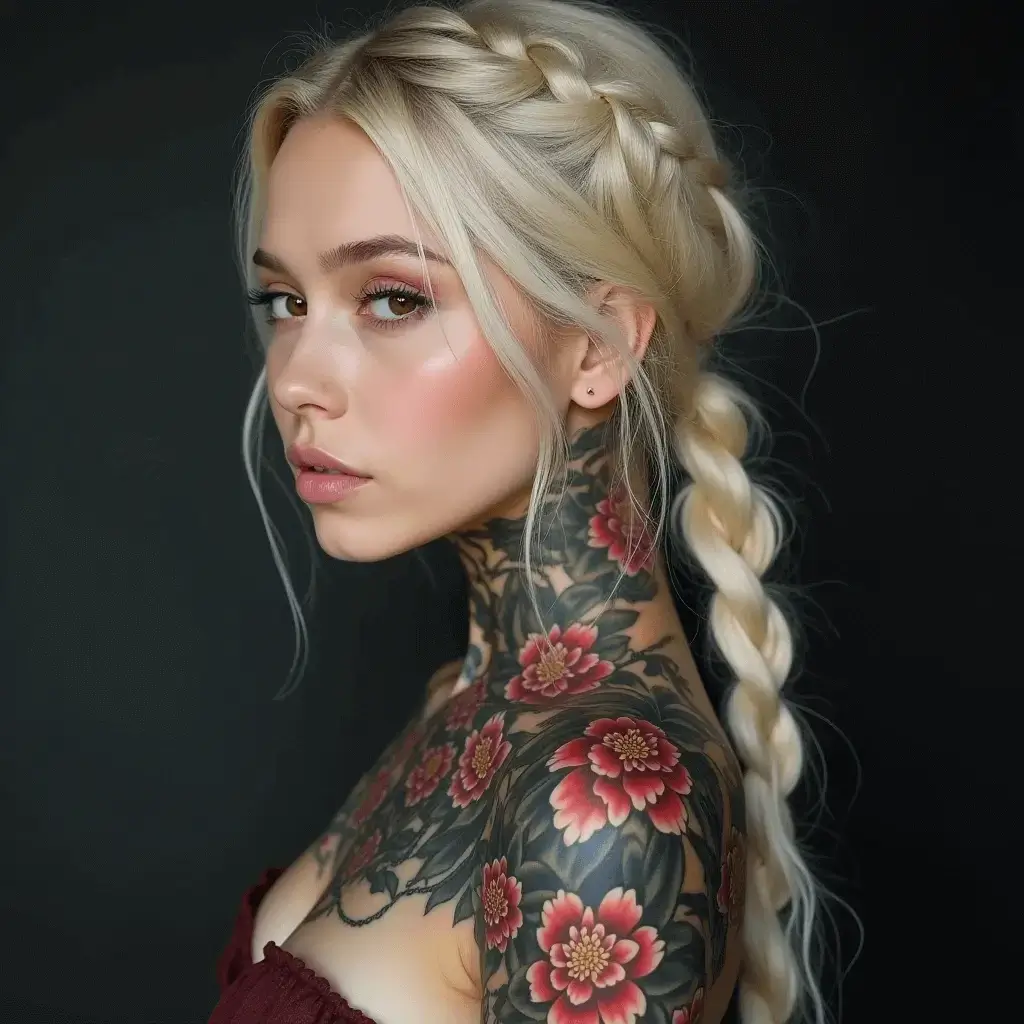 From a deep examination of artistic details, AI still faces challenges when imitating certain brushstrokes that require a "touch". After magnifying the design draft by 400% and analyzing it, it was found that the standard deviation of the random fluctuations (simulating the natural feeling of hand tremor) at the edges of the lines generated by AI was 0.2 pixels, while the standard deviation of the brushstrokes of human artists was 0.5 to 1.5 pixels. This led to the AI lines sometimes seeming "too perfect" and lacking vitality. In terms of shadow transition, AI can smoothly achieve a 256-level grayscale gradient, but compared with the concentration gradient controlled by force in traditional painting, its emotional expression intensity score is about 20% lower. However, in dimensions such as geometric symmetry, AI's performance far exceeds that of humans. The deviation of its symmetry axis can be controlled within 0.5%, while the average deviation of human designers is 3%.
Therefore, the authenticity presented by the ai tattoo generator is a kind of "selective excellence". It has achieved a score of 90 in terms of calculation, accuracy and efficiency, but when it comes to capturing that 10% of the unquantifiable artistic soul, it remains a growing apprentice. The role it is most suitable for might not be a perfect terminator, but rather an efficient collaborator who provides a solid foundation of 85 points. And that decisive 15 points still rely on the artist's discerning eyes and deft hands to ultimately add the finishing touch.
From a deep examination of artistic details, AI still faces challenges when imitating certain brushstrokes that require a "touch". After magnifying the design draft by 400% and analyzing it, it was found that the standard deviation of the random fluctuations (simulating the natural feeling of hand tremor) at the edges of the lines generated by AI was 0.2 pixels, while the standard deviation of the brushstrokes of human artists was 0.5 to 1.5 pixels. This led to the AI lines sometimes seeming "too perfect" and lacking vitality. In terms of shadow transition, AI can smoothly achieve a 256-level grayscale gradient, but compared with the concentration gradient controlled by force in traditional painting, its emotional expression intensity score is about 20% lower. However, in dimensions such as geometric symmetry, AI's performance far exceeds that of humans. The deviation of its symmetry axis can be controlled within 0.5%, while the average deviation of human designers is 3%.
Therefore, the authenticity presented by the ai tattoo generator is a kind of "selective excellence". It has achieved a score of 90 in terms of calculation, accuracy and efficiency, but when it comes to capturing that 10% of the unquantifiable artistic soul, it remains a growing apprentice. The role it is most suitable for might not be a perfect terminator, but rather an efficient collaborator who provides a solid foundation of 85 points. And that decisive 15 points still rely on the artist's discerning eyes and deft hands to ultimately add the finishing touch.
From a deep examination of artistic details, AI still faces challenges when imitating certain brushstrokes that require a "touch". After magnifying the design draft by 400% and analyzing it, it was found that the standard deviation of the random fluctuations (simulating the natural feeling of hand tremor) at the edges of the lines generated by AI was 0.2 pixels, while the standard deviation of the brushstrokes of human artists was 0.5 to 1.5 pixels. This led to the AI lines sometimes seeming "too perfect" and lacking vitality. In terms of shadow transition, AI can smoothly achieve a 256-level grayscale gradient, but compared with the concentration gradient controlled by force in traditional painting, its emotional expression intensity score is about 20% lower. However, in dimensions such as geometric symmetry, AI's performance far exceeds that of humans. The deviation of its symmetry axis can be controlled within 0.5%, while the average deviation of human designers is 3%.
Therefore, the authenticity presented by the ai tattoo generator is a kind of "selective excellence". It has achieved a score of 90 in terms of calculation, accuracy and efficiency, but when it comes to capturing that 10% of the unquantifiable artistic soul, it remains a growing apprentice. The role it is most suitable for might not be a perfect terminator, but rather an efficient collaborator who provides a solid foundation of 85 points. And that decisive 15 points still rely on the artist's discerning eyes and deft hands to ultimately add the finishing touch.